Site Preparation Guide: Grading and Fill for Construction ProjectsA project guide for Orlando, FL
A step-by-step breakdown of site prep, grading, and fill placement for Central Florida construction.
Every construction project in Central Florida — whether it is a single-family home, a commercial building, or a subdivision — begins with site preparation. Before a single footer is poured or a slab is formed, the land has to be cleared, graded, filled, and compacted to engineering specifications. Skip any of these steps, and you are building on a foundation that will settle, crack, or fail.
Understanding how site prep works helps contractors plan material needs, coordinate deliveries, and avoid costly delays. This guide walks through the full process as it applies to Central Florida projects.
What Is Site Preparation?
Site preparation is the process of transforming raw land into a buildable surface — everything that happens between buying a property and starting vertical construction. The major phases include clearing, surveying, rough grading, fill placement, compaction, and fine grading. Each phase builds on the one before it.
In Central Florida, site prep carries additional complexity because of flat terrain, sandy soils, high water table, and intense seasonal rainfall. These factors influence how much fill dirt a site needs and what compaction methods work best.
Step 1 — Site Clearing and Demolition
The first physical work on any site is clearing — removing all vegetation, trees, stumps, and root systems from the building footprint. If existing structures are on the property, they get demolished and debris is hauled off. Clearing also includes stripping the topsoil layer, which in Florida is typically a thin layer of organic material sitting on sand.
Topsoil is usually stockpiled on site for later landscaping or hauled away. The goal is to expose the native subgrade — the underlying soil that supports fill and base layers above it. In Central Florida, this subgrade is almost always sand, which drains well but requires engineered fill for structural bearing capacity.
Step 2 — Surveying and Staking
Once the site is cleared, a surveyor establishes the reference points that guide all earthwork — finished floor elevations, property boundaries, drainage flow directions, and cut-and-fill lines that tell the grading crew exactly where to remove soil and where to add it.
The surveyor works from the civil engineer's grading plan. In Florida, these plans pay close attention to drainage because flat terrain means even a few inches of grade can determine whether water flows toward a retention pond or toward a building foundation. The plan also accounts for setbacks from wetlands, easements, and flood zones — all common in Central Florida development.
Step 3 — Rough Grading
Rough grading is the heavy earthwork phase where bulldozers and motor graders cut high spots down and push material into low areas. The objective is to get the entire site within a few inches of design elevations.
On many Central Florida sites, rough grading reveals that existing soil volume is not enough to reach required grades — common on flat sites that need to be built up for flood protection. When that happens, fill dirt needs to be imported. The volume calculation comes from the engineer's cut-and-fill analysis, and getting it right is critical because underestimating fill quantities means project delays.
Step 4 — Fill Dirt Placement
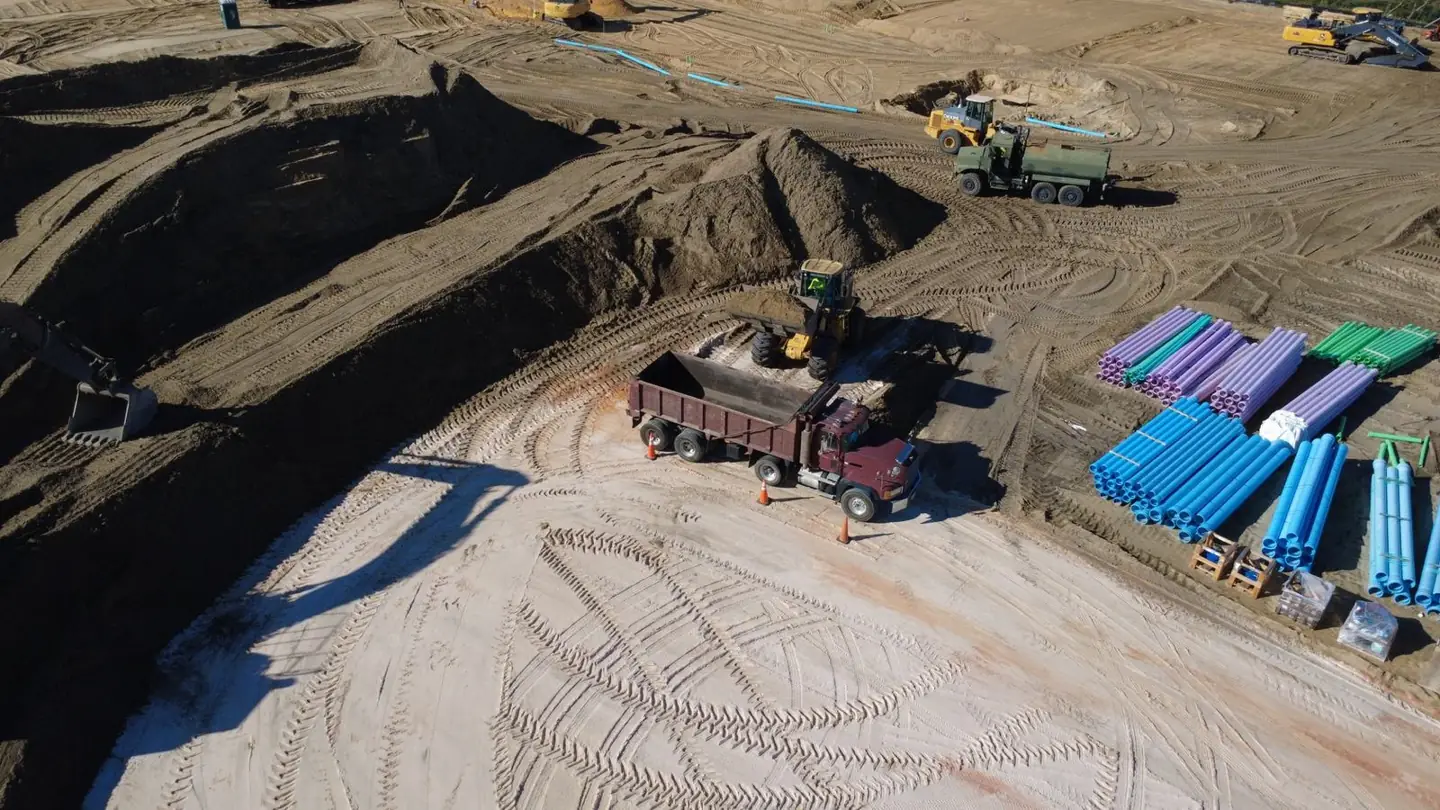
Fill dirt placement is where material delivery becomes the bottleneck or the accelerator for the project. Clean fill — sand or soil free of organic material and contaminants — is the baseline requirement. Structural fill is a higher-grade material that meets specific density and composition standards required under foundations, retaining walls, and load-bearing slabs.
Fill is placed in lifts — individual layers typically six to twelve inches thick before compaction. Each lift is spread evenly, moisture-conditioned, and compacted before the next layer goes on. Stacking too much fill without compacting between lifts leads to uneven settlement that cracks foundations months or years later.
In Central Florida, fill dirt is sourced from local borrow pits and delivered by dump truck. A tandem carries roughly 10 to 14 cubic yards per load, while a tri-axle — what we run — carries about 18. For large sites needing thousands of cubic yards, coordinating steady deliveries keeps the grading crew productive.
Step 5 — Compaction and Testing
Compaction is arguably the most critical step in site preparation — mechanically densifying fill to a specified percentage of its maximum dry density as determined by a Proctor test. Most Florida codes require 95 or 98 percent of standard Proctor density, depending on the application.
Vibratory rollers, sheepsfoot rollers, or plate compactors achieve compaction depending on soil type and area size. A geotechnical firm performs nuclear density or sand cone tests to verify each lift meets specification. If a lift fails, it must be scarified, re-moistened, and re-compacted before the next layer goes on.
Skipping compaction testing is a risk no reputable contractor takes. Settlement from poorly compacted fill causes foundation cracks, slab failures, and utility line breaks. Proper testing costs a fraction of what structural repairs would.
Step 6 — Fine Grading and Drainage
After all fill is placed and compacted, the site gets fine-graded to exact finished elevations — precision work done with a laser-guided motor grader or skid steer that brings the surface within a quarter-inch of design grades.
In Florida, fine grading is inseparable from drainage design. Flat terrain means surface drainage relies entirely on engineered slopes, swales, and retention areas. Even a residential lot needs carefully graded swales directing stormwater away from the foundation. Commercial sites include full stormwater systems — retention ponds, exfiltration trenches, or french drains — all dependent on precise grades.
Common Site Prep Mistakes to Avoid
The most expensive mistakes are the ones you discover after construction is underway. Poor compaction tops the list — invisible once covered, but it shows up as settlement and cracking months later. Using the wrong fill material is another problem. Organic soil or contaminated fill placed under a building pad will decompose, compress unevenly, and void engineering certifications.
Ignoring drainage is particularly costly in Florida — a site that holds water will saturate base layers and undermine everything built on top. Underestimating fill quantities leads to delays and rush-order premiums. Working with an experienced trucking partner who understands volumes and logistics prevents these headaches.
Site Preparation Services in Central Florida
At Alex and Family Trucking, we are the material delivery link in the site preparation chain. We haul fill dirt, structural fill, base rock, sand, and aggregate materials to construction sites across Orlando, Kissimmee, Sanford, Winter Haven, Lakeland, Daytona, and the Tampa corridor. Whether your project needs 20 loads or 200, we coordinate deliveries to match your grading schedule so your crew stays productive.
If you are planning a site prep project and need reliable material delivery, call (321) 947-9535 or request a quote. We will work with you on volumes, scheduling, and material selection to keep your project on track and on budget.
Related Articles
- How Much Does Fill Dirt Cost Per Load in Central Florida?
- How to Choose the Right Base Material for Roads and Driveways in Florida
- What Size Dump Truck Do I Need for My Project?
- Lime Rock vs Crushed Concrete: Best Choice for Florida Driveways
- #57 Stone: Uses, Benefits, and Delivery in Central Florida
Need Fill Dirt or Base Material for Your Construction Site?
Alex and Family Trucking delivers fill dirt, structural fill, and aggregate materials to construction sites across Central Florida.